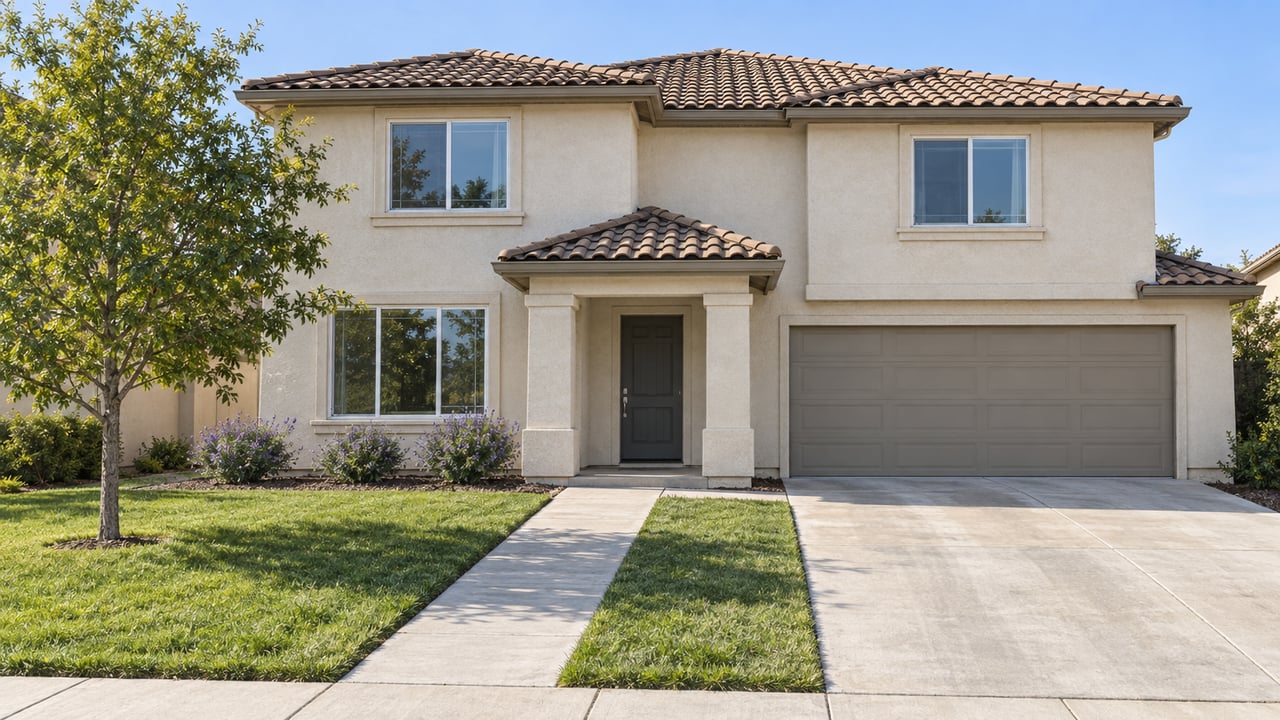
On Switchback Street in Oakhaven at Winding Creek, a finished four-bedroom Taylor Morrison home is listed at $919,000. The builder's page shows $33,809 crossed off. The price cut is the smaller part of the offer. For contracts signed October 1 through October 31, 2026, Taylor Morrison is advertising up to $55,000 in flex cash on select Sacramento-area homes. There is also an FHA 5/1 adjustable-rate mortgage starting at 4.25%, or 6.32% APR, on quick move-in homes that close by November 13.
For comparison, Freddie Mac's weekly survey put the average 30-year fixed rate at 7.28% for the week of October 1, 2026, up from 7.03% a week earlier. Mortgage News Daily's daily index read 7.57% on October 2.
That gap of roughly three points is what new construction in 95747 is selling this fall. Whether a buyer can capture it depends on conditions, caps, and dates in the fine print. Those same rules shape what a resale seller a few streets away can offer in return.
The financing incentive comes with a lender and an escrow attached
Taylor Morrison's terms split the flex cash into two kinds of money. Flex cash applied to seller-selected options or a lot premium shows up as a price reduction on the purchase agreement. Any buyer gets that, whether they pay cash or use any lender. Flex cash applied to a temporary buydown, discount points, closing costs, prepaids, or up to a year of HOA dues is a finance incentive. To get it, the buyer has to pre-apply with Taylor Morrison Home Funding before submitting an offer, finance through that lender, and use the closing agent the seller selects.
The 4.25% ARM works the same way. Taylor Morrison says it has locked in a pool of funds at that rate through its affiliated lender, available until the pool runs out or the rate expires. The offer is limited to FHA loan limits and owner-occupied homes. The 6.32% APR example assumes a $400,000 purchase with 3.5% down. Winding Creek's ready homes on that same page run from $779,960 to $939,000. A buyer at those prices should confirm with the lender whether the loan they need actually qualifies for the advertised rate.
Here is what the three builders active around Winding Creek and Sierra Vista were advertising as of early October 2026:
| Builder and community | Advertised financing | Price reference | Window as published |
|---|---|---|---|
| Taylor Morrison, Oakhaven and Mariposa at Winding Creek | 4.25% FHA 5/1 ARM, 6.32% APR; up to $55,000 flex cash | 2048 Serendipity Dr. at $939,000, down $48,824 | Contracts Oct. 1–31; ARM homes close by Nov. 13; flex-cash quick move-ins close by Nov. 30 |
| Beazer, Willow at Winding Creek | 3.99% 2/1 buydown, 6.769% APR | From $639,990; 200 Canopy Court at $685,805 | No end date printed |
| JMC Homes, Overland Village at Sierra Vista | Up to $75,000 incentive; 4.375% 10/6 ARM or 5.250% 30-year fixed | 2033 Pogonia St. at $769,990; 2073 Pogonia St. at $889,990 | Offer page lists both Oct. 30 and Nov. 13 close dates |
JMC's financing example is based on a $1,299,990 purchase, so the full $75,000 shouldn't be assumed on lower-priced homes. The offers differ in how long the low rate lasts. JMC's 5.250% is a 30-year fixed rate. Taylor Morrison's 4.25% holds for five years before it can adjust, and Beazer's 3.99% is a 2/1 buydown, so it covers only the first two years.
A $55,000 incentive can't all go toward the rate
Taylor Morrison's disclosures include a short line: "Maximum seller contributions apply." Lenders cap how much a seller can put toward a buyer's financing and closing costs. In a new-home sale, the builder is the seller, so the cap applies to the builder too.
Fannie Mae's Desktop Underwriter guidance gives a worked example. At 93% loan-to-value, interested-party contributions are capped at 3%, calculated on the lower of the sale price or the appraised value. For VA loans, the VA counts seller- or builder-funded temporary buydowns as concessions and caps concessions at 4% of reasonable value.
Run the Switchback Street home through the Fannie Mae example:
- Price: $919,000, assuming it appraises at that figure or higher.
- A 3% cap at 93% loan-to-value allows about $27,570 toward the buydown, points, and closing costs.
- The rest of a $55,000 flex-cash award can still be used, but only on options or the lot premium, which shows up as a lower price.
So for a buyer putting 7% down on a conventional loan, about half the headline incentive works as a price cut, not a rate cut. That still saves money. But a lower price and a lower rate affect your monthly payment very differently, and buyers should look at the two pieces separately.
What a 4.25% start rate becomes
The Taylor Morrison ARM is fixed at 4.25% for 60 months. After that, it adjusts once a year to the 30-Day Average Treasury Rate plus a 2.00% margin. The first adjustment can be at most 1%, each later adjustment at most 1%, and the rate can never rise more than 5% above the start rate, which puts the ceiling at 9.25%. Applying those caps gives the highest rate the loan could reach each year:
- Years 1 through 5: 4.25%
- Year 6: up to 5.25%
- Year 7: up to 6.25%
- Year 8: up to 7.25%
- Year 9: up to 8.25%
- Year 10 onward: up to 9.25%
The rate can also fall if the index falls. Either way, by year eight the worst case is close to what fixed-rate buyers are paying right now.
The 2/1 buydowns work differently. Funds held in escrow cut the payment by two percentage points in year one and one point in year two, and then the full note rate applies. The VA notes that lenders qualify the borrower on the full payment due after the buydown ends. Fannie Mae defines a "moderate" temporary buydown as no more than two points below the note rate, lasting no more than two years. So a 2/1 buydown lowers the first two years of payments, but it doesn't raise the price you can qualify for.
The resale next door has its own discounts
Resale homes in the area are getting cheaper too, through ordinary price reductions. Across Placer County in August 2026, the median existing single-family price was $692,500, up 2.6% from a year earlier. Inventory was 3.6 months, up from 3.0 in July, and the median home took 32 days to sell, up from 29. These are countywide figures. We found no Roseville-only data for that month.
Appraiser Ryan Lundquist's September 23 read on the Sacramento region puts numbers on the discounting. Over the prior couple of weeks, listings that cut their price before going into contract cut it by 6.3% on average, or $44,624. Another 53% of pendings needed no reduction at all. A third of pendings went under contract within 14 days of listing, and 18% had been on the market more than 90 days. He also found more canceled and expired listings at the top of the price range than under $600,000.
"Buyers have more power right now, so sellers need to move to meet them."
A $44,624 average reduction is close to what the builders are offering. The difference is the conditions. A resale price cut comes with no required lender, no seller-chosen escrow, and no contract deadline. The resale buyer pays the market rate, though, unless the seller pays to lower it.
That is the resale seller's move. A seller-paid 2/1 buydown falls under the same Fannie Mae and VA caps as a builder's. If the seller wants to give more than the cap allows, the rest goes into the price, just as it does for Taylor Morrison's flex cash. Builders and resale sellers end up working with the same tools. What's different is the builder's pre-locked rate pool and the October deadline. None of these sources shows that builder incentives are causing resale price cuts. The data only shows both happening at the same time.
What to compare before you sign anything
- Your month-61 payment. For an ARM, ask for the payment at the year-six cap as well as the start payment.
- How the incentive is split. Get it in writing: how much goes to price, how much to financing, and how much the cap for your loan type and down payment allows.
- The lender quote without the incentive. Ask the builder's lender and an outside lender to quote the same loan without the promotion, so you can see what the incentive is actually worth.
- The deadlines. Taylor Morrison's offers require contracts by October 31 and closings by November 13 or November 30. Beazer's page prints no end date, and JMC's page shows both October 30 and November 13. Confirm the date for your specific home before you plan the move around it.
- A buydown request on any resale. Ask the seller what a seller-paid buydown would cost them compared with the price cut they're considering. On a home that has sat for 60 days, the two numbers may be closer than either of you expects.
FAQ
Do I have to use the builder's lender to buy a Winding Creek home? No. Under Taylor Morrison's published terms, you don't have to use its affiliated lender or closing agent to buy. You do have to use both to get the financing incentives.
Is the Taylor Morrison price cut separate from the flex cash? Yes. Its quick move-in price reductions of up to $60,000 apply to contracts signed as of October 1, 2026, don't require the affiliated lender, and are available to cash buyers. Taylor Morrison describes them as separate from any financing incentive. Its offers can't be combined unless the terms or an incentive addendum allow it.
Can a resale seller in West Roseville offer a rate buydown? Yes, within the same interested-party contribution limits that apply to builders. The VA allows a seller, builder, lender, or the borrower to fund the buydown escrow.
If you're weighing a Winding Creek or Sierra Vista home against a resale in 95747 before the October deadlines, The Alfano Group can lay the builder's incentive terms next to a resale offer that includes a seller-paid buydown. We'll show you the payment for each option in year one, year two, and year six. Schedule a consult and bring the builder's incentive addendum with you.
This article is general information, not legal, tax or financial advice. Consult a qualified professional about your situation.
